Short answer: no leash can stop a dog from pulling. Training does that. But the right leash and the right grip take most of the strain off your hands while you train. Look for a padded handle, a fixed length of 4–6 ft, a leash you can hold with both hands and a solid clip. And never wrap the leash around your hand or fingers.
Why a pulling dog hurts your hands
When a dog lunges, all of its pull lands on whatever part of the leash you are holding. A thin, flat strap concentrates that force on a narrow strip of your palm and fingers. Repeated pulls cause soreness and blisters, and a sudden lunge can drag the leash through your hand and cause a friction burn.
Wrapping the leash around your hand feels more secure, but it is the riskiest habit: if your dog bolts, the loop tightens around your fingers or wrist and you cannot let go.
What to look for in a leash for a dog that pulls
- A padded handle. A cushioned loop spreads the load across your palm instead of one line across your fingers.
- Something to hold further down. A round, braided rope is easy to grip part-way along its length, so your second hand can take some of the pull.
- A fixed length of 4–6 ft. Long enough for a loose leash, short enough to stay in control. Skip retractable leashes for dogs that pull.
- A solid clip. Check the clasp and the stitching or joints before every walk, and replace a leash that shows wear.
- Visibility. If you walk early or after dark, a reflective rope helps drivers see you.
How to hold the leash so it doesn’t hurt
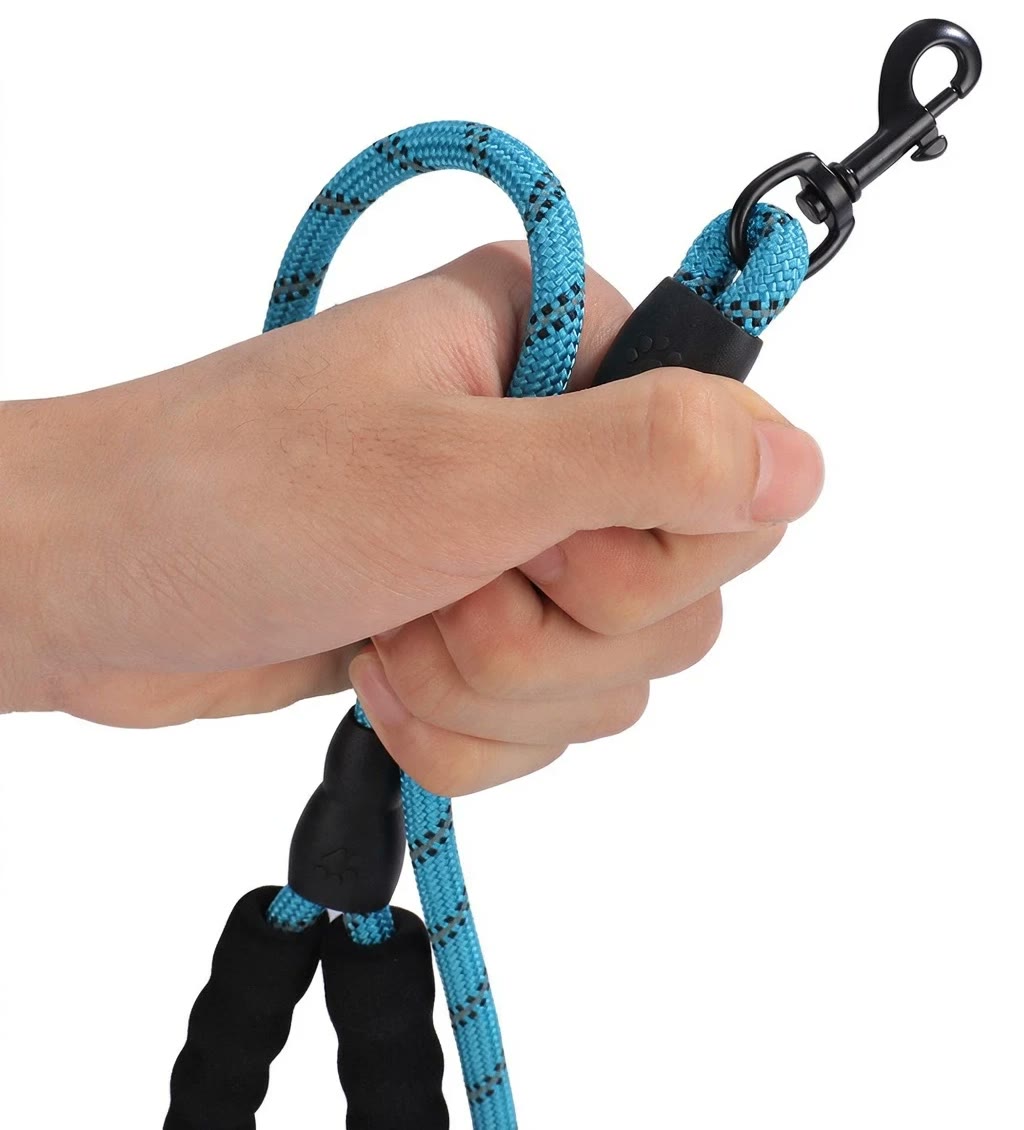
- Slide your hand through the handle loop and close your fingers around it, so the loop rests across your palm, not your fingers.
- Hold the rope further down with your other hand. This hand absorbs the first jolt of a pull, and your handle hand is the backup.
- Keep your elbows bent and close to your body. Your arms act as shock absorbers and your core takes the load instead of your shoulder.
- Never wrap the leash around your hand, wrist or fingers.
- Wear gloves in cold weather or while you are still training a strong puller.
Make pulling stop working
Dogs pull because pulling gets them where they want to go. The goal is to make a loose leash the only thing that moves the walk forward:
- Stop when the leash goes tight. Stand still until your dog eases back and the leash relaxes, then walk on.
- Reward a loose leash. Mark and reward the moments your dog walks beside you, especially early in the walk.
- Change direction. If your dog surges ahead, turn and walk the other way so your dog has to follow you.
- Keep sessions short. A few focused minutes at the start of each walk beat one long, frustrating session.
- Consider a harness. Many trainers suggest a well-fitted harness instead of a flat collar for dogs that pull hard, to keep pressure off the neck.
If your dog lunges at other dogs or people, or pulls hard enough that you feel unsafe, work with a certified professional trainer.
Our padded rope leash
We sell one leash, and it ticks these boxes. It won’t stop a dog from pulling, as no leash does, but it makes the walks you spend training more comfortable:
- Padded foam loop handle
- Round braided nylon rope, reflective along its full length, easy to hold part-way down
- 5 ft (1.5 m) long, 3/8 in (1.0 cm) wide, 133 g (4.7 oz)
- Rotating zinc alloy clip that attaches to a collar or harness
- Made for medium and large dogs, about 20–75 lb (10–35 kg)
- Blue, pink or lime green, $5.00 USD with free shipping to the contiguous US
Frequently asked questions
Is a padded leash handle worth it for a dog that pulls?
Yes, if your hands get sore. A padded handle spreads the force of a sudden pull across more of your palm, so long or training-heavy walks are more comfortable. It does not stop the pulling itself; training does that.
What leash length is best for a dog that pulls?
A fixed leash of 4 to 6 ft suits most everyday walks. It leaves enough slack to reward a loose leash while keeping your dog close enough to manage. 5 ft is a common middle ground.
Should I use a retractable leash for a dog that pulls?
Usually not. A retractable leash keeps tension on the line and gives more length when the dog pulls, which rewards pulling. The thin cord can also burn or cut skin if you grab it.
Will a new leash stop my dog from pulling?
No leash on its own stops pulling. Use a comfortable leash and a well-fitted harness while you train loose-leash walking, and ask a certified trainer for help if your dog lunges or pulls very hard.